


Microsoft Teams Voice and Calling Solutions
Simplify PSTN calling in Microsoft Teams with secure,
scalable, operator-managed voice connectivity.
Modernise enterprise communications with Microsoft Teams voice, PSTN connectivity, customer engagement, and cloud-based communication services.
Enable secure, scalable Teams calling while simplifying legacy infrastructure, reducing operational complexity, and supporting hybrid workforces globally.
Unrivalled Global Coverage
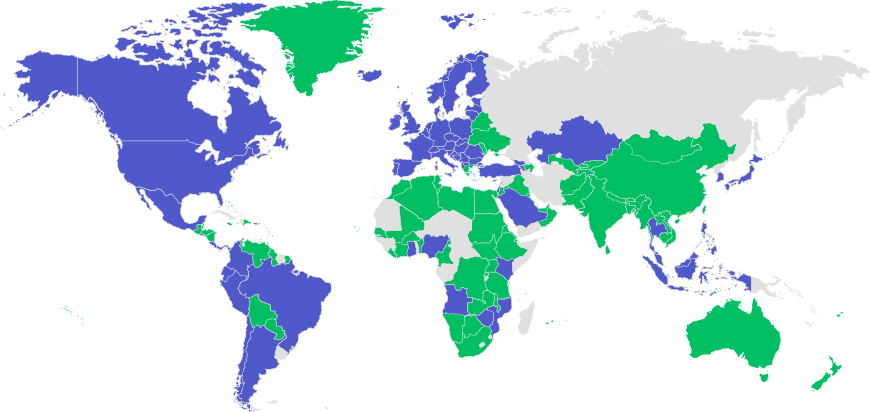
Certified Operator Connect Countries
Other Teams Voice Services
Voice Experience
Operator Connect
Satisfaction Score
Users
Reliability
What’s Covered
- What is Driving Teams Voice
- Your Microsoft Teams Voice Options
- Operator Connect vs Direct Routing vs Calling Plans
- Global Complexity Considerations
- Microsoft Teams Voice Migration Strategy
- Pricing, Licensing & Right-Sizing
- Building a Business Case
- How SCB Global Supports Modern Teams Voice Environments
What Is Driving The Move To Teams Voice?
If you’re relying on disconnected voice systems, legacy PBX infrastructure, multiple carriers, or fragmented communication tools, it becomes harder to support users, maintain visibility, control costs, and scale efficiently.
At the same time, hybrid working, global compliance requirements, and evolving customer expectations are changing how communication services need to operate. As organizations look to optimize new technologies such as AI in their operations, voice needs to be fully and seamlessly integrated into the communications environment
Common Challenge
Multiple disconnected communication platforms
Legacy PBX infrastructure approaching end of life
Separate voice, messaging, conferencing, and contact centre tools
Supporting hybrid and remote workforces
Global telecom and compliance requirements
Limited visibility into communication performance and usage
Expensive carrier contracts and legacy telecom services
Disconnected customer engagement channels
Typical Impact
Fragmented user experience and operational silos
Rising maintenance costs and limited scalability
Increased operational complexity and vendor sprawl
Inconsistent communication experiences across users and locations
Difficult governance, emergency calling, and PSTN management
Poor reporting and operational oversight
Unpredictable costs and inefficient resource allocation
Fragmented customer experiences and inefficient workflows
- Consolidate voice, meetings, messaging, and collaboration into a more unified environment
- Simplify communication management across users, devices, and locations
- Replace legacy PBX and carrier infrastructure with cloud-based voice services
- Support hybrid working with a consistent communication experience
- Improve operational resilience and scalability
- Centralise governance, reporting, and policy management
- Enable global PSTN connectivity through Operator Connect or Direct Routing
- Extend Teams with customer engagement, messaging, and workflow capabilities
Your Microsoft Teams Voice Options
Geographic Coverage
Routing Flexibility
Operational Ownership
Compliance Requirements
Existing Telephony Infrastructure
Migration Strategy
The Three Main Options
Operator Connect
Best For:
Rapid deployment and simplified PSTN management.
- Microsoft-certified operator model
- No SBC management required
- Simplified administration within Teams
- Fast deployment and onboarding
Direct Routing
Best For:
Advanced routing flexibility and legacy integration.
- Custom dial plans and routing logic
- Legacy PBX and SIP integration
- Compliance recording support
- Greater telephony control
Microsoft Calling Plans
Best For:
Straightforward calling requirements in supported regions.
- Microsoft-managed PSTN services
- Simplified procurement
- Native Teams integration
- Suitable for smaller deployments
Features Overview
Feature
SBC Global Required
Deployment Speed
Infrastructure Management
Best For
Teams Admin Center Integration
Compliance & Custom Routing
Global Flexibility
Operator Connect
No
Fast
Operator Managed
Simplicity & rapid deployment
Native
Medium (provider dependent)
Depends on provider
Direct Routing
Yes
Moderate to Complex
Customer or Partner Managed
Complex routing & hybrid environments
Partial
Advanced
High
Microsoft Calling Plans
No
Fast
Microsoft Managed
Simple calling requirements in selected regions
Native
Very Limited
Limited
Operator Connect vs Direct Routing vs Calling Plans
- Deployment complexity
- Compliance requirements
- Operational ownership
- Geographic coverage
- Routing flexibility
- Migration strategy
- Existing telephony investments
Choose Operator Connect if you:
- Want the fastest Teams calling deployment
- Prefer a Microsoft-certified operator-managed service
- Do not want to manage SBC infrastructure
- Need simplified administration within Teams
Choose Direct Routing if you:
- Require advanced routing flexibility
- Need legacy PBX connectivity or Teams-native contact centre capabilities
- Have complex compliance requirements
- Need greater control over telephony architecture
Choose Microsoft Calling Plans if you:
- Microsoft-managed PSTN services
- Simplified procurement
- Native Teams integration
- Suitable for smaller deployments
When Dealing With Global Complexity
- Regional PSTN regulations
- Emergency calling obligations
- Number availability & porting
- Data residency requirements
- Compliance recording
- Local carrier dependencies
- Inconsistent service availability
- Operational ownership gaps
- Careful architecture planning
- Operational governance
- Strict provider evaluation
- Resilience strategy
- Migration sequencing
Microsoft Teams Voice Migration Strategy
- Existing PBX infrastructure
- Number porting timelines
- User adoption and training
- Compliance recording requirements
- Contact centre dependencies
- Regional telecom regulations
- Hybrid voice environments
- Other legacy systems
- Operational support models
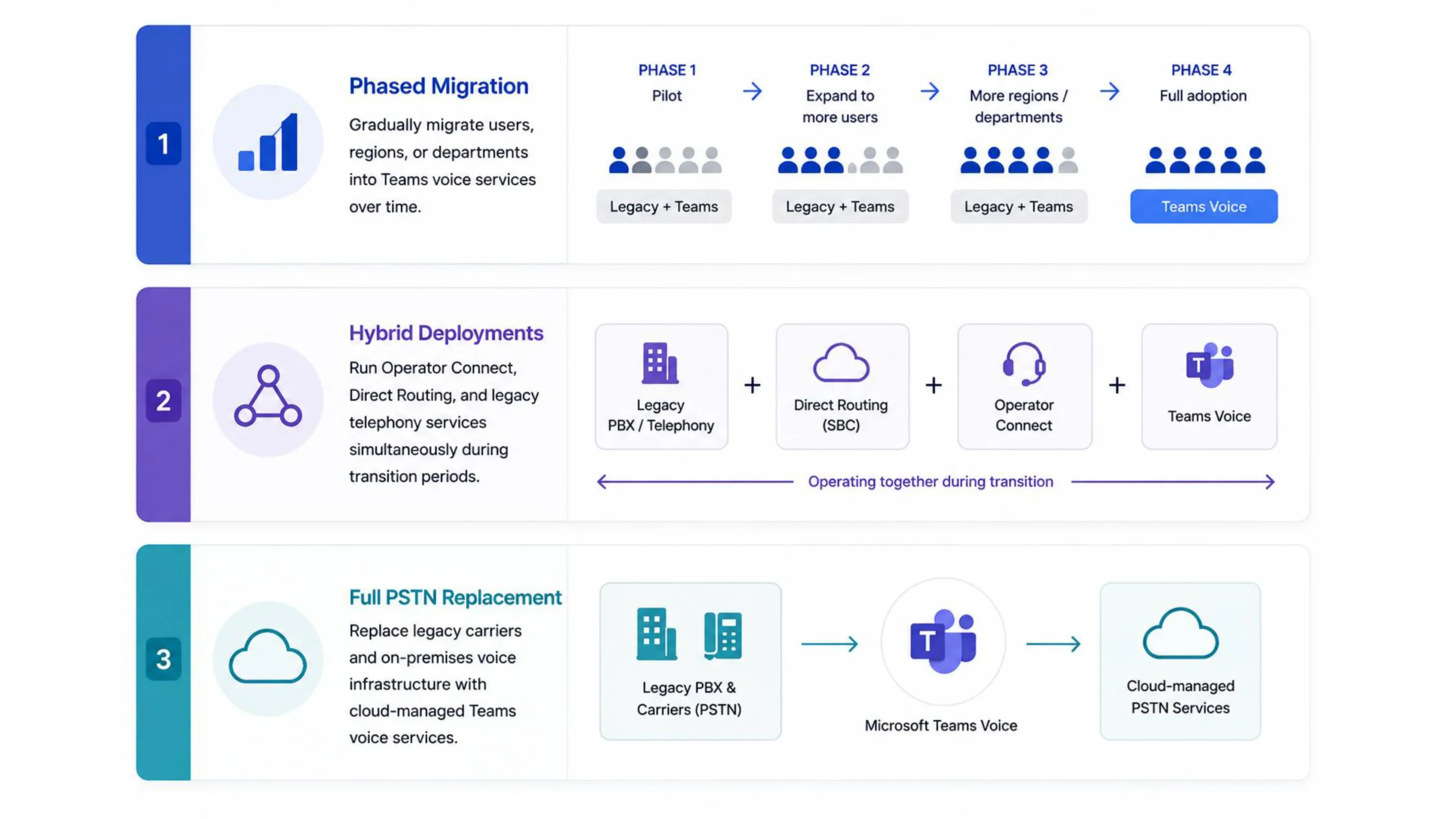
-
Phased Migration
Gradually migrate users, regions, or departments into Teams voice services over time.
-
Hybrid Deployments
Run Operator Connect, Direct Routing, and legacy telephony services simultaneously during transition periods.
-
Full PSTN Replacement
Replace legacy carriers and on-premises voice infrastructure with cloud-managed Teams voice services.
-
Reducing Migration Risk
Migrating enterprise voice services to Microsoft Teams can quickly become complex, particularly when legacy telephony, global PSTN requirements, compliance obligations, and hybrid environments are involved.
Without careful planning, migrations can introduce operational disruption, inconsistent user experiences, governance gaps, and unnecessary project delays.
SCB Global helps you reduce migration risk by providing strategic guidance, architecture planning, and operational support throughout the migration process.
- Assess your existing telephony environment
- Plan number porting and PSTN migration
- Design hybrid migration strategies
- Align migration with operational and compliance requirements
- Reduce disruption for users and IT teams
Teams Voice Pricing, Licensing, and Right-Sizing
When evaluating Teams voice pricing, consider the following:
- Teams Phone licensing requirements
- PSTN consumption models
- Bundled vs pay-as-you-go calling
- Regional calling costs
- Support and SLA models
- Migration and operational costs
- Unnecessary licensing spend
- Underutilised telecom services
- Unrequired numbers (particularly wrt shared calling)
- Overlapping carrier contracts
- Operational inefficiencies
- Usage patterns
- Compliance requirements
- Geographic needs
- Required numbers and services
- Future scalability requirements
Building The Business Case For Microsoft Teams Voice
- Simplifying communication environments
- Reducing operational complexity
- Improving employee experience
- Supporting hybrid work
- Modernising customer engagement
- Consolidating communication platforms
- Cost reduction opportunities
- Productivity improvements
- Operational efficiency and resilience
- Governance
- Scalability
- Customer experience outcomes
- Modernising and future-proofing
- Making the environment ‘AI-Ready’
How SCB Global Supports Modern Teams Voice Environments
- Teams-native contact centre functionality
- Omnichannel communications
- SMS and WhatsApp integration
- Compliance recording services
- Hybrid Operator Connect and Direct Routing environments
- Multi-carrier routing and resilience strategies
- Integration with CRM and legacy platforms
Why Businesses Choose SCB Global For Microsoft Teams Voice
- Support multi-country PSTN and number requirements
- Handle complex features and requirements
- Simplify Microsoft Teams voice deployments
- Evaluate Operator Connect and Direct Routing strategies
- Reduce operational complexity across voice environments
- Improve resilience and routing flexibility
- Extend Teams with native communication and customer engagement capabilities
- Align Teams voice services with compliance and governance requirements
Customer Success
The "EASY" button for transitioning from legacy complexity to OPTO Intelligence.

Global Food Manufacturer
A globally recognised food manufacturer turns to SCB Global to make projected life time savings of $10m+ on its global enterprise communications.

Global Precision Products Manufacturer
A globally renowned manufacturer of precision products migrates its Avaya-centric communications to Teams Voice with SCB Global.

Heavy Equipment Supplier
A large multisite supplier of heavy equipment and machinery, migrate its legacy voice from Cisco to Teams voice with CX functionality.
How SCB Global Supports Modern Teams Voice Environment
- Operator Connect vs Direct Routing strategy
- Global PSTN coverage and compliance requirements
- Migration planning and coexistence approaches
- Licensing, commercial models, and right-sizing
- Hybrid Teams voice environments
- Teams-native communication and customer engagement capabilities
What Happens After You Contact SCB Global?
-

Discovery & Requirements Review
SCB Global reviews your Microsoft Teams environment, telephony estate, operational requirements, and global coverage needs.
-

Teams Voice Architecture Assessment
Evaluate whether Operator Connect, Direct Routing, or Microsoft Calling Plans best align with your business requirements.
-

Coverage Evaluation
Assess global PSTN coverage, number availability, resilience requirements, and compliance considerations.
-

Migration & Deployment Planning
Coordinate number porting, onboarding, operational readiness, and governance planning.
-

Deployment & Ongoing Optimisation
Support rollout, reporting, operational governance, and long-term Teams voice strategy.
A proven, expert-led process to design, deploy and optimise your Microsoft Teams voice solution.
Discovery & Requirements Review
SCB Global reviews your Microsoft Teams environment, telephony estate, operational requirements, and global coverage needs.
Outcome:
Clear understanding of your environment and business objectives.
Team Voice Architecture Assessment
Evaluate whether Operator Connect, Direct Routing, or Microsoft Calling Plans best align with your business requirements.
Outcome:
Recommended Teams voice architecture and approach.
Coverage Evaluation
Assess global PSTN coverage, number availability, resilience requirements, and compliance considerations.
Outcome:
Validated coverage assessment.
Migration & Deployment Planing
Coordinate number porting, onboarding, operational readiness, and governance planning.
Outcome:
Detailed migration plan and operational readiness.
Deployment & Ongoing Optimisation
Support rollout, reporting, operational governance, and long-term Teams voice strategy.
Outcome:
Successful deployment and continuous optimisation.
You're not alone at any stage.
SCB Global works with your team and trusted partners to ensure a smooth transition to Microsoft Teams Voice.