


Article Two - Disconnected
When everything works, but nothing works together
Decades of investment in communications technology have left many enterprises managing a complicated mix of systems, providers and processes. We take a look at how to make sense of this complexity, decide what needs to stay and what needs to change, and where to begin.
One of the frustrating things about enterprise communications is that everything can be working perfectly well, while the overall environment remains remarkably difficult to manage. The bigger and more distributed the organization, the bigger the challenge.
The phones ring and people meet on Teams. Emails drop into inboxes. The contact center handles customer inquiries. And the service desk keeps everything running. So far, there doesn’t seem to be a problem.
Then the comms team is asked to change call routing across several countries, integrate a newly acquired business or produce a consolidated report from half a dozen different platforms.
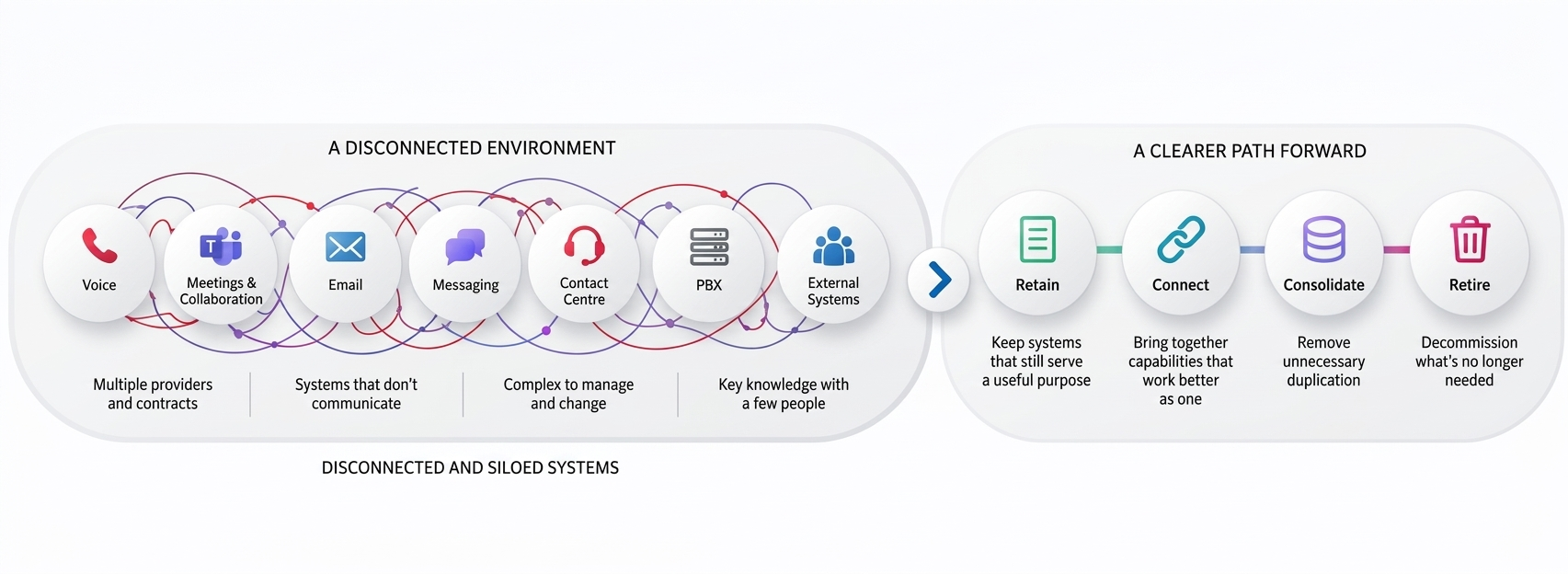
What feels like it should be a fairly straightforward request quickly becomes a much bigger undertaking. Different providers need coordinating, contracts complicate matters, systems don’t communicate with each other and, often, the vital technical knowledge sits with just a handful of people.
None of this is because the tools aren’t working. It’s because they’re all working in isolation.
How did we get here?
The reality is, of course, that comms environments aren’t designed from scratch. They evolve over time.
New acquisitions bring new telephone systems, local offices choose local carriers, and contact center capability is constantly upgraded. And while collaboration tools may have become the go-to internal option, the PBX is often still doing the heavy-lifting for in- and outbound calling.
So now, when you look across the entire organization, you see a comms environment that’s expensive to operate, difficult to change, and increasingly disconnected from the way people actually work. Added to which, there’s a risk that the next ‘evolution’ will only add to the complexity.
That doesn’t mean ripping everything out and starting again. That’s neither practical nor, in a lot of cases, possible. At the same time, standing still isn’t much of an option. Businesses need to improve productivity, respond to changing customer expectations, and take advantage of new capabilities, particularly as AI becomes part of everyday operations.
For comms professionals, the question then becomes about managing through change – accommodating the technology that needs to stay and adding new without adding to the complexity you’re trying to reduce.
Building a business case for change
As we’ve seen above, some changes to the environment are simply the costs of doing business while some, like acquiring legacy through acquisition, are the natural consequence of growth.
Arguably, the more valuable changes are those undertaken as part of modernization or transformation programs. And because they’re planned, there’s a real opportunity to tackle some of the fragmentation and complexity with each initiative.
Here, the natural starting point, of course, is the business case. What does the organization actually want to achieve, and where will programs make the biggest difference?
Priorities vary. For some enterprises, the immediate opportunity may be reducing costs by consolidating overlapping platforms, carrier agreements or equipment that’s increasingly expensive to maintain. For others, it might be a dedicated simplification exercise, or a focus on improving employee productivity.
Then there’s the wider opportunity to introduce new capabilities, whether that’s connecting customer information with communications, automating routine processes or taking advantage of the various performance benefits of Copilot.
Whatever the objective, the important thing is to understand what the existing environment is costing the business, what needs to improve, and what achieving those improvements will involve.
Deciding what needs to change
But knowing what you want to achieve doesn’t necessarily make deciding what to change any easier. Particularly when some systems are perfectly fit for purpose, others support specialist requirements and local regulations mean different arrangements may need to remain in place.
In our experience, it helps to break the decisions down into four broad categories:
- Retain: keep systems that still serve a useful purpose.
- Connect: bring together capabilities that would benefit from working more closely.
- Consolidate: remove unnecessary duplication across platforms, services and providers.
- Retire: decommission technology that’s no longer needed or has become costly or difficult to support.
Making those decisions requires a clear understanding of how the different systems depend on one another, including the people and processes they support. Something that appears redundant may still serve an important operational function, while another system may be creating unnecessary work elsewhere in the business.
This is where an assessment of the existing estate can help identify changes that deliver an immediate benefit, alongside the more substantial work needed to create a simpler, more coherent environment over time.
Finding the right place to start
Often, the most useful starting point is to look at the everyday activities that have become unnecessarily complicated.
Bringing a new location online, changing call routing across countries or producing a consolidated service report can all reveal where time and effort are being lost. Understanding what’s involved, and why, helps establish whether the answer lies in replacing a system, connecting it to something else or changing how it’s managed.
For many enterprises, Microsoft Teams will play an important role in creating a more consistent communications experience. But there’s still the question of what sits behind it, which systems need to work together and where local requirements call for a different approach.
After decades of investment, few enterprises will have the luxury of starting again from scratch. Nor would they necessarily want to. The opportunity is to build on what already works, address what doesn’t and make sure each new investment leaves the business with an environment that’s easier to manage and better able to support what comes next.
Further reading
If you are interested in reading or hearing more about modernizing enterprise communications, we are planning to release an extensive guide on the subject as well as run a series of events in the new year. To be kept informed,
About us
SCB Global is a Microsoft-first intelligent communications provider, bringing together Voice, Customer Experience (CX) and AI to transform the way organizations connect, communicate and engage.
We help businesses move beyond traditional communications to create smarter, more connected experiences that improve customer satisfaction, empower employees and deliver measurable business value.
Get more from your communications with SCB Global. Contact us today to see if we can help you imagine getting more from your communications and interactions.