


Article Three - Connected
Why bringing voice into Teams could be a bigger opportunity than you think
If you’re already using Microsoft Teams for collaboration, you could be missing a trick by not using it for voice too. Let’s explain why – and it might not be what you think.
Our previous article in this series ‘When everything works, but nothing works together’ looked at how years of investment can leave enterprises managing a disconnected mix of systems, providers and processes.
Here, we explore the next logical step: how to bring services together, reduce unnecessary duplication and support greater simplification across the business.
For organizations already using Microsoft Teams, the good news is that adding Teams Voice can be the path of least resistance to a more connected and less complex estate. It is also very possible that you already have the licenses.
Your people already use Teams to meet, message and collaborate. Bringing external calling into that familiar environment means fewer separate applications for employees to navigate, with opportunities for IT to consolidate infrastructure and manage services more consistently – in the cloud.
But there’s also a wider opportunity to establish a common communications foundation that makes it easier to integrate business applications, connect information and introduce new capabilities – including AI – as you modernize.
Getting immediate value
The clearest benefit is a simpler experience for employees. Instead of switching between Teams for meetings and collaboration and a separate telephone system for external calls, they can do everything through one familiar application. And whether they’re working from an office, at home or on the move, they have access to a more consistent set of communications capabilities.
For IT, there’s an opportunity to simplify the environment behind that experience. Bringing voice into Teams can reduce the number of separate platforms to maintain, consolidate administration and make it easier to provision users and manage services across the business.
There’s a commercial case, too. Retiring traditional PBX infrastructure, reducing overlapping licenses and consolidating supplier arrangements can lower ongoing costs, while cloud delivery reduces the need to maintain and upgrade some of the underlying equipment.
Of course, the savings depend on what the enterprise can actually retire or consolidate. But for businesses already paying for Microsoft 365, extending an existing investment into enterprise voice can offer a more practical route to simplification than introducing another standalone communications platform.
Making it work across the enterprise
While connecting Teams Voice may look like a relatively modest change, at enterprise scale, it can be significant.
For multinational organizations, there’s an opportunity to extend the benefits across the entire business, bringing more employees onto a common communications platform, finding further opportunities to consolidate services and infrastructure across locations, and establishing more consistent arrangements for managing and supporting voice services.
And there’s considerable flexibility in how this can be achieved. Microsoft offers several connectivity options, including Operator Connect, Direct Routing, Calling Plans, and Teams Phone Mobile, allowing organizations to accommodate different carriers, local regulations, and numbering requirements.
This means businesses can work towards a common Teams experience without requiring identical technical arrangements in every country. Existing systems can remain connected where necessary, while migration takes place in phases to suit different locations and user groups.
Of course, architecture still matters. Decisions about connectivity, retained systems, and supplier arrangements will influence how easily the environment can be managed, and how much existing infrastructure can eventually be retired.
Done well, the result is a more consistent communications experience across the enterprise, supported by an environment that’s simpler to operate and easier to develop further.
A foundation for what comes next
For many enterprises, Microsoft 365 is already central to how employees work and how IT manages the digital workplace. Identity and access are managed through Microsoft Entra ID, security policies are established, and employees use Microsoft applications to share information and collaborate. Copilot and other AI capabilities are increasingly becoming part of that environment, too.
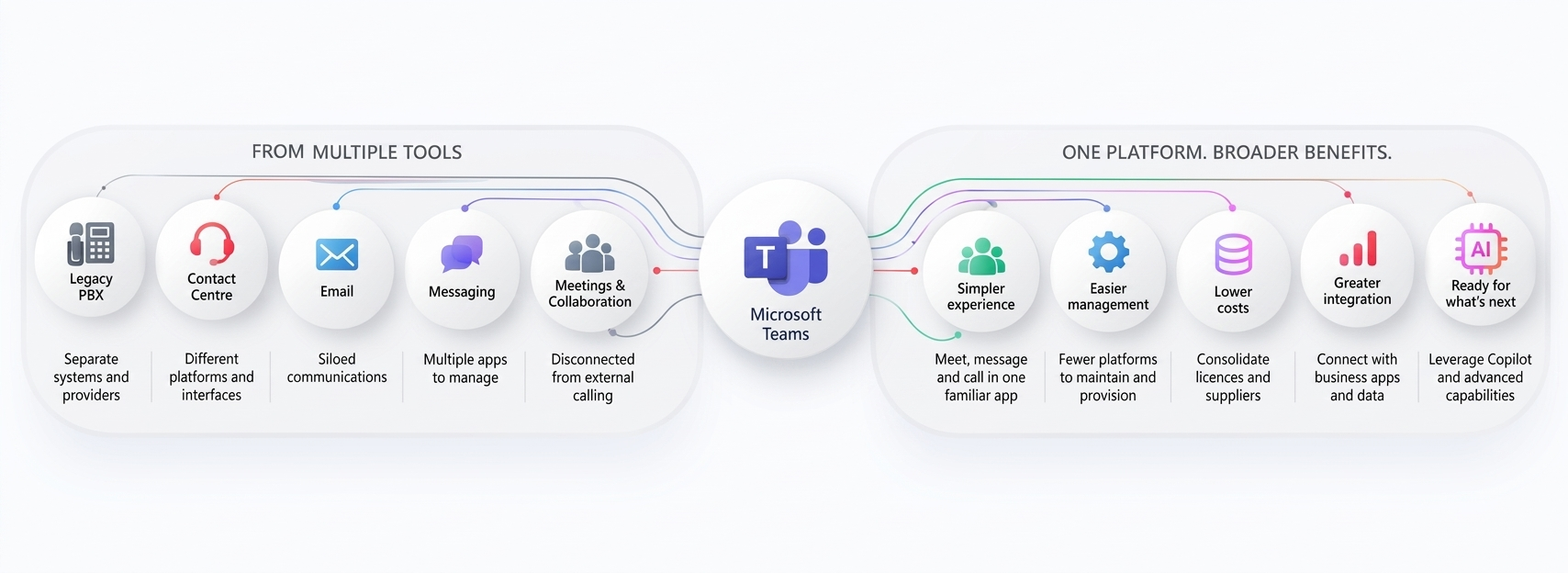
Bringing enterprise voice into Teams means it can draw on these existing capabilities, rather than continuing to operate as a separate service.
This also creates the potential to make communications a more integrated part of how the business operates. Customer conversations could be connected to CRM records, employees could access relevant information during calls, and interaction data could support analytics, automation, and AI.
And you’ll start to see the difference when communications become part of everyday business processes. When employees can access the information they need without switching between systems. When customer interactions can inform what happens next. And when the data generated by those conversations can be used to improve services, automate routine tasks, and support better decisions.
These capabilities don’t arrive automatically with Teams Phone. They require additional integration, thoughtful design, and appropriate controls. Bringing voice into the Microsoft environment does, however, give organizations a more coherent starting point for developing them.
That’s worth thinking about when designing the architecture today. Decisions about connectivity, retained systems, and how services are managed can influence what will be possible in the years ahead.
For enterprises already invested in Microsoft 365, extending into voice offers the immediate benefits of simpler communications, while opening the door to much closer integration between communications and the wider business.
Further reading
If you are interested in reading or hearing more about modernizing enterprise communications, we are planning to release an extensive guide on the subject as well as run a series of events in the new year. To be kept informed,
About us
SCB Global is a Microsoft-first intelligent communications provider, bringing together Voice, Customer Experience (CX) and AI to transform the way organizations connect, communicate and engage.
We help businesses move beyond traditional communications to create smarter, more connected experiences that improve customer satisfaction, empower employees and deliver measurable business value.
Get more from your communications with SCB Global. Contact us today to see if we can help you imagine getting more from your communications and interactions.