


Article Four- Integrated
When communications becomes part of the workflow
What happens when the conversation is only one part of the job? In this article, we look at how integrating communications with business applications and processes can make everyday work easier.
In our last article Why bringing voice into Teams could be a bigger opportunity than you think, we looked at how adding Teams Voice helps simplify communications and lay the foundation for a simpler, more connected estate. This time around, we’re taking a step further to explore what happens when we bring communications and wider business workflows closer together.
Let’s start with a common, everyday scenario.
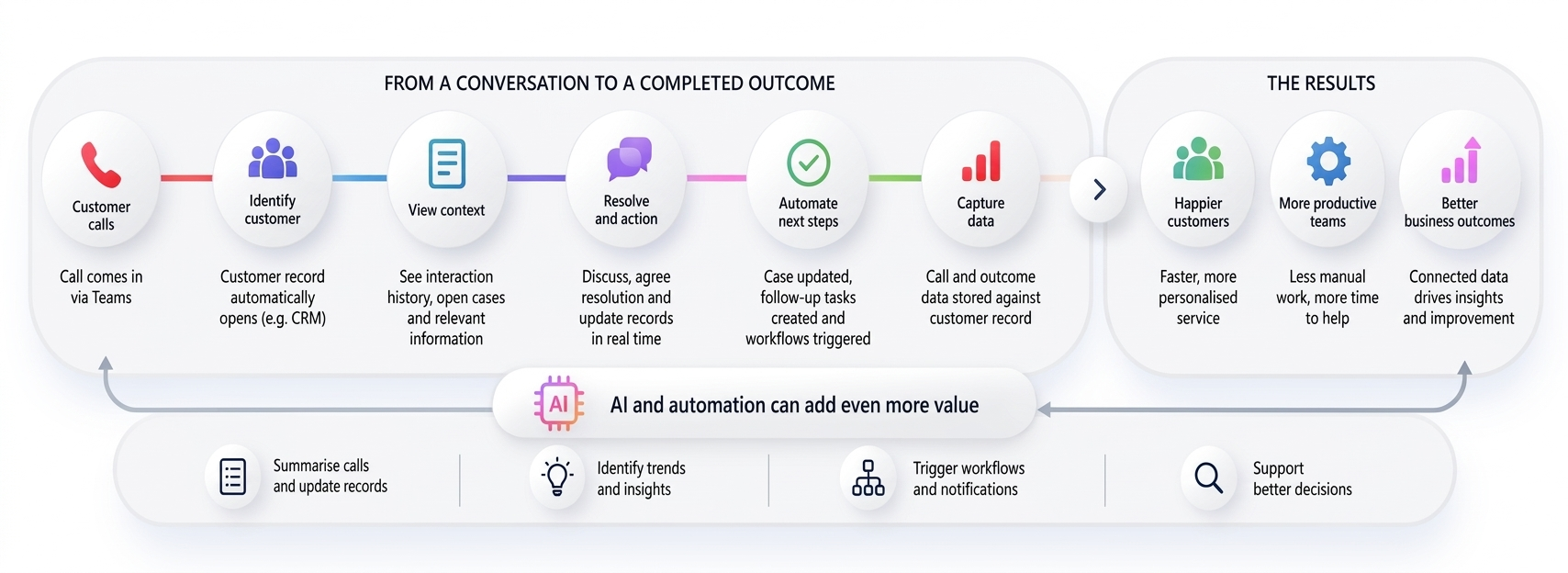
A customer calls the service team. The agent answers, with the caller’s account details, interaction history, and open cases automatically displayed on screen. They discuss the issue, agree on a resolution, and close the call. The interaction is logged against the customer record, the case status is updated, and any necessary follow-up tasks are triggered through the appropriate workflows.
Now imagine the same call without that integration. The agent asks for an account number, searches the CRM, opens another application to find the service history, and probably puts the customer on hold while they track down the information they need. Post-call, they then have to manually update the relevant records and action whatever needs to happen next.
In both scenarios, there’s a conversation taking place. In just one, there’s an integrated workflow doing much of the work that surrounds it.
Agents spend more time helping customers and less time navigating applications. Customers aren’t left waiting while information is retrieved. And when the call ends, the next steps are already in motion. Apply this across hundreds or thousands of interactions, and you’re looking at a meaningful improvement in agent productivity, service quality, and customer experience.
The same principle extends well beyond customer service, from sales and employee support to incident management and other business processes where communications play a part.
Start with the journey, not the application
It’s tempting here to begin with the technology, thinking first about the applications to connect, what APIs are available, and what processes can be automated.
Perhaps a more useful starting point is to follow a particular customer or employee journey from beginning to end. Where do people – either colleagues or customers – have to repeat information? Where does context get lost between teams? Where do manual activities slow down the next stage of the process? And much more. This way, it’s easier to identify the integrations worth making and those that aren’t.
Sometimes, the improvement is relatively modest. For example, automatically displaying a customer record when a call arrives, creating a case after an interaction, or assigning a follow-up task can each remove unnecessary work. These aren’t new ideas but they’re not always in place.
Other requirements call for a more tailored approach. Let’s think about an organization dealing with a service disruption. Typically, several teams need to coordinate their response. Someone identifies the issue, the contact center needs updating, customer notifications have to be prepared, and call routing or announcements may need changing. Once the disruption is resolved, those temporary arrangements need to be reversed.
With the right integration, administrators could schedule emergency announcements, change routing across affected contact center queues, send SMS notifications, and automatically restore normal service arrangements afterwards.
None of these individual capabilities is particularly revolutionary and innovation doesn’t always mean introducing something completely new. The benefit comes from integrating them into a coherent operational process that requires less manual intervention and is easier to manage.
Of course, that doesn’t mean integrating everything you possibly can. The question is whether bringing systems and processes together will genuinely solve a business problem or improve the way something gets done. Otherwise, you risk introducing more complexity without much to show for it.
Comms data becomes business data
There’s another dimension to integrating communications – one that goes beyond a single use case.
A conventional call record might tell you who called, how long they waited, and who answered. Bring that information together with CRM and service records, and you can begin to understand why they called, whether the issue was resolved, and what happened afterwards.
A short call, for example, might appear efficient until you discover that the customer had to call back twice because the original problem wasn’t resolved.
By combining communications information with business data, organizations can understand how well their processes are working, identify recurring problems, and make better decisions about where improvements are needed.
Data integration also creates possibilities for AI. An intelligent assistant working with a transcript might summarize a customer call. While that’s useful in itself, give it access to CRM records, business knowledge, and workflows, and it could also check whether the customer has an existing support case, recommend a resolution based on previous incidents, or draft a follow-up email with the relevant details already included. And that’s incredibly valuable.
Taking that a step further, AI can provide insights back to the business to facilitate service improvements, or help in extracting sentiment and context from calls to again aid a better understanding of the customer and business operations. We will explore more about that in future articles.
Making integration worthwhile
The value of your integration should ultimately be measured by the problems it solves for colleagues, customers, and the business. So, ask: Are customers getting their issues resolved more quickly? Are your teams spending less time on manual tasks? And does IT have a better understanding of how its services are performing? If the answer’s yes, it’s working!
Further reading
If you are interested in reading or hearing more about modernizing enterprise communications, we are planning to release an extensive guide on the subject as well as run a series of events in the new year. To be kept informed,
About us
SCB Global is a Microsoft-first intelligent communications provider, bringing together Voice, Customer Experience (CX) and AI to transform the way organizations connect, communicate and engage.
We help businesses move beyond traditional communications to create smarter, more connected experiences that improve customer satisfaction, empower employees and deliver measurable business value.
Get more from your communications with SCB Global. Contact us today to see if we can help you imagine getting more from your communications and interactions.